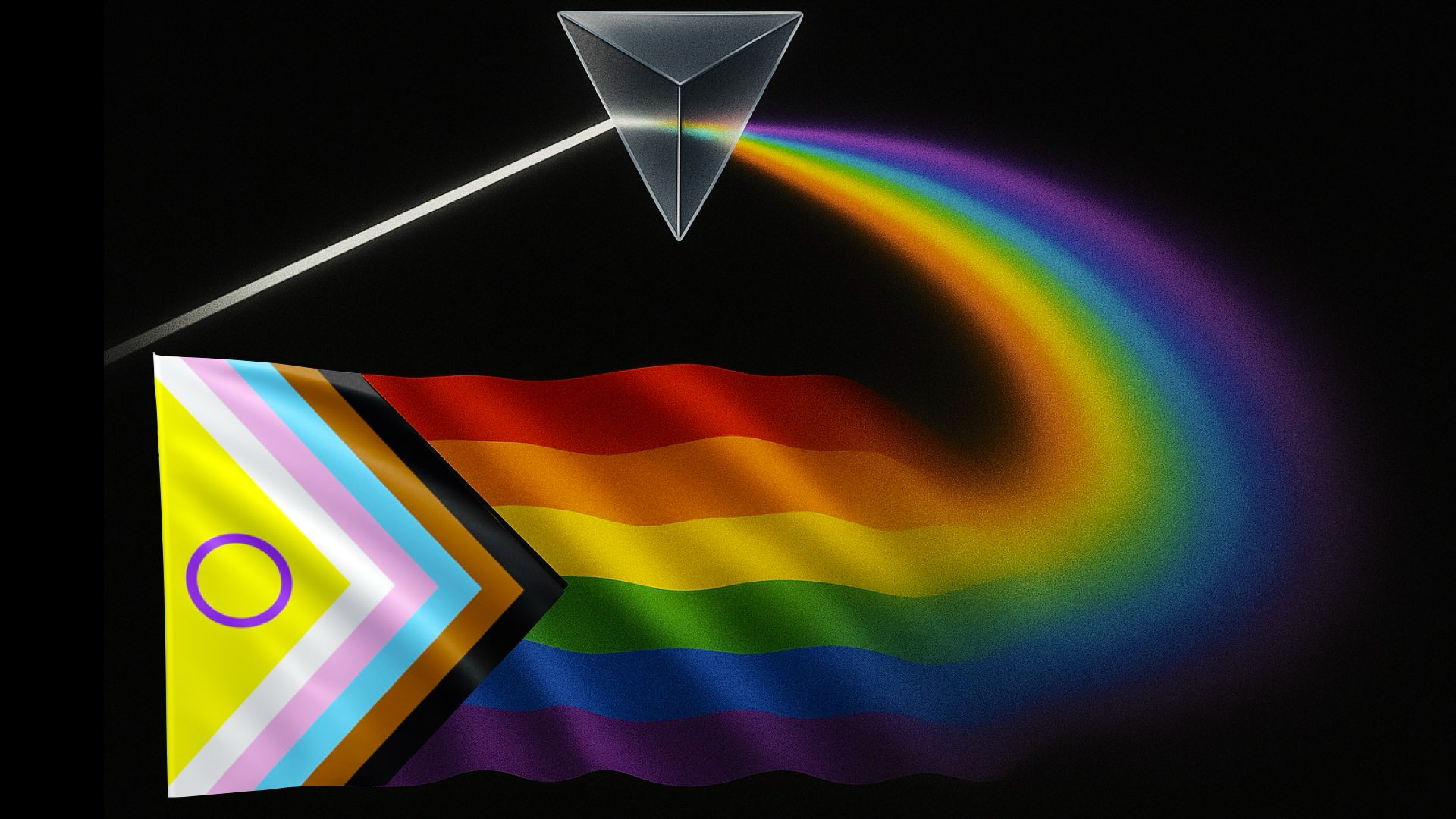
Hello, and welcome to episode 36 of The Spectrum. This was recorded on March 4, 2026. Today we’re going to be looking at human biology. Many of the regressive voices promoting anti-LGBTQ laws are claiming to talk about biological truth. We’ve spoken about that before but today we’re going to get into the details of it. So, strap in and prepare to move beyond 6th grade biology! First, we’re going to be looking at same-sex sexual behavior among animals in the wild and then we’re going to looking at human biology and how it relates to sex and gender.
I’m not a doctor and I’m not a biologist. But, I am someone that actually paid attention in school and continued to learn as an adult. Much of the science and history we learn in grade school is simplified. Students don’t need all the details to get a basic understanding of the subject but they need to realize it’s only a basic understanding. Reality is almost always more complex. Basing policy and laws on simplifications made to aid in grade school learning isn’t just wrong, it’s plain stupid. So, today, we’re going to explore those things and we’re going to frame it in terms of the objections most often raised about LGBTQ people.
Let’s start with reproduction as the sole purpose of sex. Many people insist that sex should only occur within marriage and that it should only occur when trying to conceive a child. I don’t have a problem that. If it’s the way you want to live your life. It’s your choice. But, biology would suggest that sex didn’t solely evolve to create children. Sex, in the animal kingdom is often used for purposes other than reproduction.
Bonobos are the species mostly closely related to humans genetically. We share more DNA with them than any other species. Bonobos often engage in sex with each other. They use intimacy to reduce social tensions and promote peace. Bonobos find sex pleasurable as most humans do. While they don’t pair bond like many humans do, they treat sex as a sort of social lubricant to keep the peace and resolve conflict. They clearly aren’t engaging in sex for reproductive purposes. And, it’s often with partners of the same sex.
These are jus the most closely related animals to us. Non-reproductive sex is not uncommon in other apes, dolphins and many other animals.
Many people call sexual acts between two men unnatural because they say, “it’s an exit, not an entrance.”. The idea is that using something that primarily excretes waste shouldn’t be used for sex. If that’s they way you feel about it, don’t do it. But, it’s not unnatural. Animals do it all the time.
Male lions often nuzzle, groom and mount each other. It’s not about dominance as these behaviors last for years and individuals show jealousy or preferences.
Many of the voices trying to persecute transgender people are saying things like, “you can’t change biology” but, sadly, they seem to be living in that middle school biology class and haven’t progressed to the complexities of actual biology.
Let’s take eye color as one example. We were taught in school that the gene for brown eyes is dominant and blue eye genes were recessive. To have blue eyes, you have to get two blue eye genes. Getting one of each results in brown eyes. Many years ago, I took a genetic test to aid in genealogy research. One of the things it told me was that based on my genes, I had a 75% chance of having blue eyes. My first thought was that made no sense. I had been taught that my genes completely determined my eye color. But, it turns out that’s not right. My genes suggested I would have blue eyes, but other factors influenced that and I don’t. They aren’t brown either and that’s another indication that the grade school biology lesson was incomplete.
Sex is similarly oversimplified. We were taught that if you have two X chromosomes you are a female and an X and Y made you a male. Nice and simple. It’s a shame the real world pays no attention to grade school biology text books because it’s more complicated. A lot more complicated.
Did you know that there are people with only a single X chromosome. This is called Turner’s Syndrome and while these individuals appear phenotypically female they lack one sex chromosome.
Klinefelter syndrome occurs when there are too many sex chromosomes. These people are XXY. The appear phenotypically male but they have an extra sex chromosome and there can be more.
There is a specific gene called the SRY gene. This gene appears on the Y chromosome and it is the closest thing to a determiner as to whether a fetus develops as male or female. At this point, you might say, “it’s the SRY gene that determines if you are a male or female. If you have an SRY gene you are a male. If you don’t you are a female.”
It’s a reasonable supposition given what you’ve seen so far. But, nature’s response is, “hold my beer”.
If the SRY gene is not present on the Y chromosome or fails to activate even if present, the fetus develops as a female. But, it’s important to understand that sometimes even if the gene is present, it may not activate. Sweyer’s Syndrome is the condition of having a mutated SRY gene or a missing one.
Some people born with conventional XY chromosome pairs (including the SRY gene) don’t respond to male sex hormones. Their bodies appear phenotypically female. They may not find out about their condition until puberty when they fail to begin menstruating. Are they male or female? Genetically they look like males, but physically they look like females. The condition is called Androgen Insensitivity Syndrome and affects between 2 and 5 in 100,000. In the US alone there are 3,000 to 15,000 people like this.
And, there is a class of people with intersex characteristics. They have some traits of both sexes or more often ambiguous sexual differentiation. In the past, doctors would often make a determination about what sex they though the child should be at birth and take what they considered to be corrective action even without consulting the parents.
I’ve used the word “phenotypically” and I should probably define it, “Phenotype” is the observable traits or characteristics of an organism while “genotype” is it’s complete set of genetic material. You can see that you can define maleness by phenotype and you can also define it by genotype but though these usually agree they don’t always and sometimes they can be ambiguous.
It gets even more complex when a person has some cells with one set of DNA and other cells with a different set of DNA. This is called chimerism and happens when two zygotes fuse very early in prenatal development. Essentially, two twins become one. Another condition called mosaicism happens when a mutation occurs in early development and some cells have the original DNA and others have the mutation.
You might think that everything about your phenotype is determined entirely by your DNA, your genotype, but that’s not the case at all. How genes activate or fail to activate can be heavily influenced by their physical environment and so, as we’ve seen, phenotype and genotype may not match at all.
So, what is a male and what is a female? The answer to that is complicated. What’s clear is that maleness and femaleness is not determined at conception but only much later in fetal development. Any fetus could develop either way depending on which genes activate, what mutations occur on those genes and the physical environment of the fetus. It’s possible that your phenotype sex and your genotype sex may not even match.
And, none of this says anything about the distinction between male and man or woman and female. We usually use those words interchangeably, at least for adults, but that’s also an oversimplification.
Most of us have heard the claim made by many transgender people that their gender – their sense of who they are – differs from their physical sex. How is that possible?
It’s possible because gender is not the same thing as physical sex. Gender happens in the brain while sex manifests in the body. In recent years, there has been research on how the brains of transgender people differ from their cisgender counterparts. This research is not yet definitive, but it is compelling in that there are measurable brain differences. The brain development of transgender women is often more similar to that of cisgender women and the brains of transgender men are often more similar to cisgender men. It’s important not to read too much into these studies at this point. They can’t be used to identify transgender people. There is a wide variety in human development and we’re talking about statistical averages here. But, it lends credence to the claims that transgender people make. Their brains may more closely resemble those of their cisgender counterparts. So, what defines who this person is? Is it their phenotype, genotype or their brain structure?
I can’t answer these questions. That’s really the point here. Sex and gender are not simple binary conditions and they don’t always track together. To claim that we understand these things well enough to tell people that they have to be what our narrow-minded definitions want them to be is both cruel and frankly, stupid, especially when the definitions being foisted upon us are blatantly at odds with what we know to be true about human biology.
I hope this helps clarify why arguments about what is “natural” just don’t make any sense.
Thanks for watching and if you have a story about LGBTQ life you would like to share, please let me know at spectrumpodcasthope@gmail.com. It’s through our stories that we can take our issues from the abstract and show the straight, cisgender world who we really are. If you are watching on YouTube, liking the videos and subscribing can help us get these stories visible to a wider audience.
Until next time, take care.
 The Spectrum
Leave a comment